What Is Multi-Level Car Parking? A Beginner’s Guide
Urban India is growing vertically — and so should its parking. As cities like Mumbai, Delhi, and Bengaluru face increasing vehicle density and shrinking land availability, conventional surface parking is no longer sustainable.
For developers, architects, and infrastructure planners, multi-level car parking systems offer a practical, scalable, and future-ready solution.
This beginner’s guide explains what multi-level parking is, how it works, its types, benefits, and why it has become essential in modern real estate projects.
What Is Multi-Level Car Parking?
Multi-level car parking (MLCP) is a parking structure that allows vehicles to be parked on multiple levels or floors within a compact footprint. Instead of spreading cars horizontally across valuable land, vehicles are stacked vertically — either through ramps or automated mechanical systems.
In simple terms:
More cars. Less land. Higher efficiency.
These systems can be:
- Fully automated
- Semi-automated
- Ramp-based structured parking
They are commonly used in residential towers, commercial complexes, malls, hospitals, IT parks, and mixed-use developments.
Why Multi-Level Parking Is Becoming Essential
- Rapid Urbanization
India adds millions of vehicles each year. However, land availability remains fixed. Multi-level parking maximizes limited space without compromising accessibility.
- Real Estate Economics
For builders and developers, parking is no longer a compliance requirement — it’s a value driver. Efficient parking design:
- Improves project feasibility
- Enhances buyer confidence
- Accelerates sales closure
- Increases premium positioning
- Regulatory Requirements
Municipal development authorities increasingly mandate structured parking in high-density developments.
Types of Multi-Level Car Parking Systems
- Ramp-Based Multi-Level Parking
This is the traditional model where drivers manually park their cars on different levels connected by ramps.
Best for:
Large malls, airports, public infrastructure projects.
Advantages:
- Lower mechanical complexity
- Familiar user experience
Limitations:
- Requires more space
- Less space-efficient compared to automated systems
- Semi-Automated Parking Systems
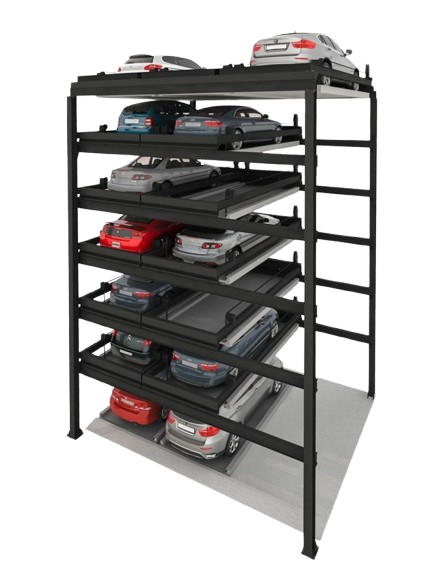
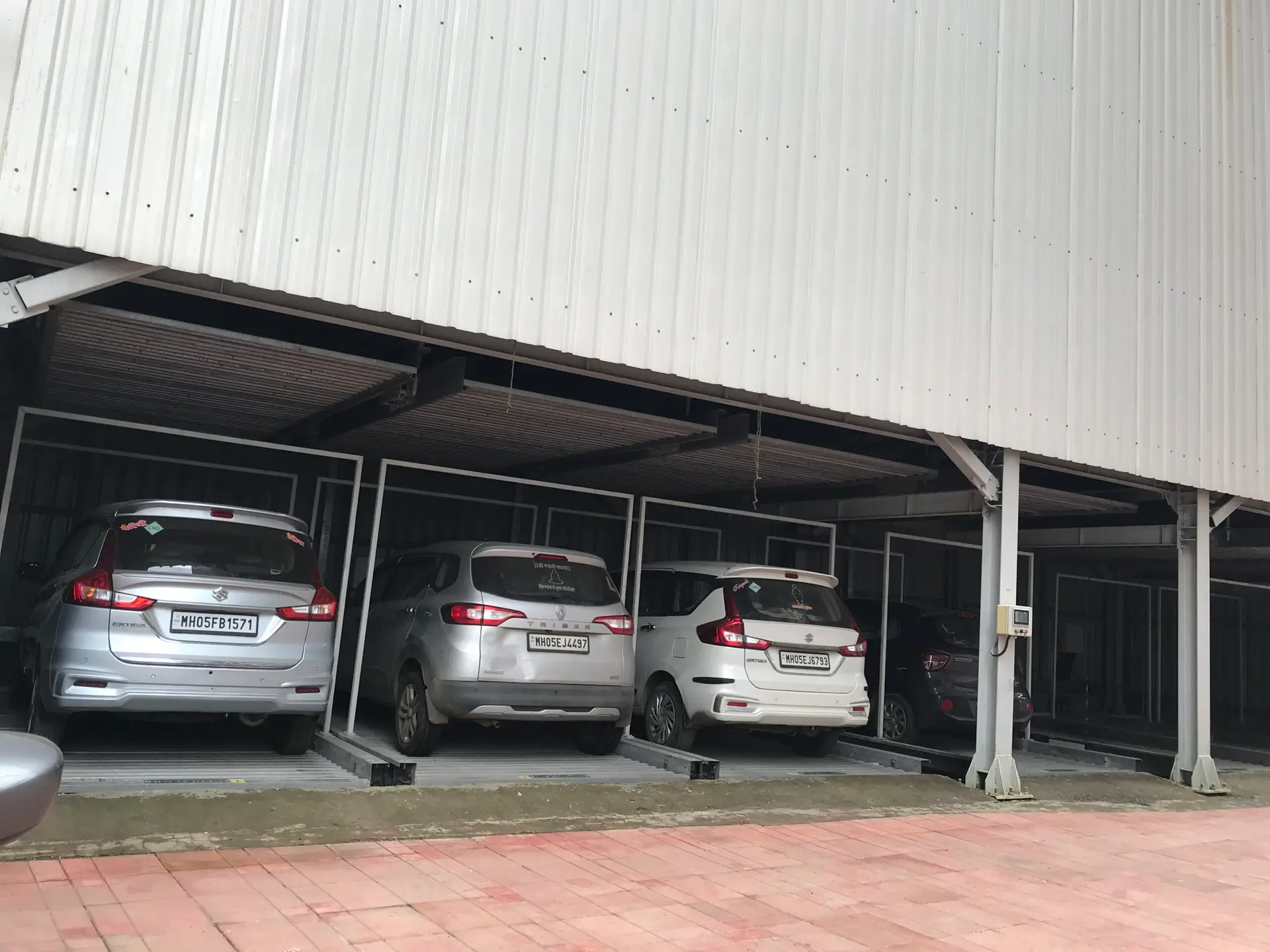
These systems use mechanical platforms or lifts to stack vehicles vertically. The driver parks the car on a platform, and the system lifts or shifts it into position.
Common configurations include:
- Puzzle parking
- Stack parking
- Tower parking (semi-automated)
Best for:
Residential buildings, mid-sized commercial developments.
- Fully Automated Multi-Level Parking
In fully automated systems, the driver leaves the vehicle at an entry bay. Robotics, lifts, and transfer systems automatically move the car to an available slot.
Key Features:
- No human driving inside the structure
- Higher safety
- Optimized space usage
- Integrated software control systems
Best for:
Premium residential towers, IT parks, smart city projects.
How Does Multi-Level Parking Work?
While mechanisms vary, the core principle remains consistent:
- Vehicle enters designated bay
- System scans dimensions and weight
- Automated lifts or mechanical platforms move the vehicle
- Vehicle is stored in a vertical grid
- Retrieval occurs through automated sequencing
Advanced systems integrate:
- Smart sensors
- PLC control panels
- IoT monitoring
- Fire and safety automation
- Power backup systems
Benefits of Multi-Level Car Parking
- Space Optimization
Up to 3–5 times more vehicles can be accommodated in the same footprint compared to conventional parking.
- Higher Project Value
Efficient parking improves project positioning in competitive real estate markets.
- Enhanced Safety
- Reduced human error
- Controlled vehicle movement
- Limited unauthorized access
- Environmental Efficiency
- Reduced internal driving time
- Lower carbon emissions
- Optimized land use
- Faster Vehicle Retrieval
Modern automated systems offer quick turnaround time, improving user satisfaction.
Multi-Level Parking in India: Growing Demand
Cities across India are witnessing a shift toward structured and automated parking systems. With increasing vehicle ownership and limited land parcels, developers are prioritizing vertical parking infrastructure to remain competitive.
From residential complexes to commercial hubs, multi-level parking has become a strategic infrastructure investment — not just an operational necessity.
Key Considerations Before Installing Multi-Level Parking
For developers and project planners, important factors include:
- Plot size and layout
- Soil and structural feasibility
- Power supply availability
- Traffic flow design
- Local municipal compliance
- Long-term maintenance planning
A feasibility assessment is essential to determine the most suitable parking configuration.
The Future of Urban Parking
As smart cities evolve, parking will increasingly integrate with:
- Digital access systems
- App-based vehicle retrieval
- EV charging integration
- Data-driven space optimization
Multi-level parking is not just about stacking cars — it is about building intelligent urban infrastructure.
Conclusion
Multi-level car parking systems represent the future of efficient urban development. By combining engineering innovation with smart space utilization, they address one of the biggest challenges facing modern cities: parking congestion.
For developers, it’s an opportunity to:
- Optimize land use
- Enhance project appeal
- Increase asset value
- Deliver long-term sustainability
As urban density rises, vertical parking will no longer be optional — it will be essential.