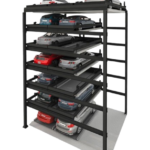
Why Parking is No Longer Just a Compliance Requirement
In today’s high-density urban real estate market, land cost is at an all-time high. Every square foot matters. Yet many builders still treat parking as a regulatory necessity rather than a strategic asset.
Modern car parking systems for builders are no longer about just accommodating vehicles. They are about:
-
Maximizing saleable area
-
Increasing project efficiency
-
Enhancing property value
-
Improving buyer perception
-
Accelerating sales velocity
For developers planning residential towers, commercial complexes, mixed-use projects, or premium developments — parking strategy directly impacts profitability.
The Problem with Conventional Ramp Parking
Traditional ramp-based parking consumes excessive space. It requires:
In metro cities, this becomes a major financial drain. When FSI is precious, dedicating 30–40% of basement space to ramps and driveways is no longer efficient.
This is where automated and mechanical car parking systems change the equation.
What is a Modern Car Parking System?
A car parking system for builders refers to mechanical or automated structures that stack or store vehicles vertically or horizontally with minimal space consumption.
Common types include:
These systems are engineered to maximize parking capacity within limited land footprints.
Key Benefits of Car Parking Systems for Builders
1. Maximize Land Utilization
Automated parking can increase vehicle capacity by 2x to 4x compared to conventional methods.
For developers, this means:
In high-cost land markets, this directly improves project feasibility.
2. Increase Project ROI
When parking is optimized:
-
Construction cost per car reduces
-
Revenue per square foot increases
-
Premium pricing becomes easier
Buyers are willing to pay more in projects that offer organized, secure, and modern parking solutions.
3. Improve Buyer Confidence & Brand Image
Today’s buyers expect convenience and innovation.
A well-designed automated parking system signals:
For luxury and high-rise projects, automated parking is becoming a differentiator.
4. Faster Approvals & Regulatory Compliance
Many urban development authorities now encourage structured parking systems to reduce on-road congestion.
Smart parking solutions help builders:
-
Meet parking norms effectively
-
Reduce basement depth requirements
-
Improve traffic flow planning
This simplifies architectural planning and approvals.
5. Reduced Construction Complexity
Without large ramps:
-
Excavation depth can reduce
-
Structural load distribution improves
-
Basement ventilation planning becomes easier
Mechanical parking systems can be modular, reducing construction delays.
Why Premium Developers Are Adopting Automated Parking
Leading developers understand that parking is no longer backend infrastructure — it’s part of the value proposition.
Automated parking helps them:
-
Position projects as future-ready
-
Justify premium pricing
-
Market “smart living” concepts
-
Reduce long-term operational chaos
In metro cities like Mumbai, Pune, Bangalore, and Delhi NCR, automated parking systems are increasingly integrated in new developments.
Commercial & Mixed-Use Projects: Even Higher Impact
For commercial projects:
-
Parking directly affects leasing potential
-
Corporate tenants demand organized vehicle management
-
Visitor parking efficiency impacts brand perception
For malls, IT parks, hospitals, and retail spaces, structured parking enhances operational efficiency.
Cost vs Value: The Real Perspective
Many builders initially focus on the installation cost of mechanical parking systems.
However, the better question is:
How much revenue does optimized parking unlock?
When land cost per square foot is high, saving even 1,000–2,000 sq ft of saleable area can outweigh the entire parking system investment.
Parking should be evaluated as a profit enabler, not an expense.
Choosing the Right Car Parking System for Your Project
Before finalizing a parking solution, developers should evaluate:
Working with an experienced parking system provider ensures proper layout planning, load calculations, and compliance.
Future of Car Parking Systems in India
With increasing vehicle ownership and shrinking urban land parcels, the demand for:
will continue to grow.
Builders who integrate smart parking at the design stage — not as an afterthought — will gain a competitive advantage.